

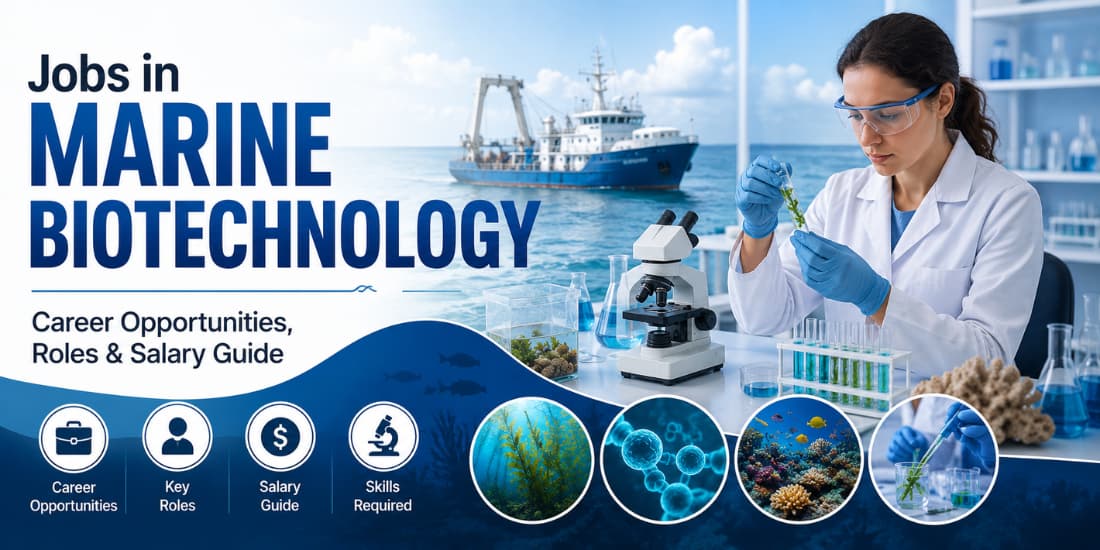
Oceans cover more than 70% of the planet, yet scientists have mapped less than a quarter of the seafloor and identified only a small fraction of marine species. That gap between what we know and what’s actually down there is exactly why jobs in marine biotechnology are multiplying so quickly.

Pharmaceutical companies are screening deep-sea sponges for cancer-fighting compounds. Food-tech startups are growing algae-based proteins to feed a growing population. Coastal governments are hiring biotechnologists to restore coral reefs and clean up polluted waters. None of this work happens without trained people, and that’s created a real hiring gap across labs, universities, government agencies, and private companies.
This guide walks through what marine biotechnology actually involves, the job roles available at every career stage, the skills and degrees employers look for, realistic salary ranges, and where the field is headed over the next decade. Whether you’re a student picking a major or a professional considering a switch, you’ll leave with a clear picture of how to build a career in this space.
What Is Marine Biotechnology?
Marine biotechnology is the application of biological tools and techniques to marine organisms algae, fish, bacteria, corals, sponges, and other sea life to develop products and solutions for medicine, food, energy, and environmental protection.
It sits at the intersection of marine biology, molecular biology, chemistry, and genetic engineering. Instead of studying the ocean purely to understand it, marine biotechnologists study it to extract value from it: a new antibiotic compound, a hardier strain of farmed fish, or a biofuel made from algae.
Some of the core activities in this field include:
- Isolating bioactive compounds from marine organisms for drug development
- Improving aquaculture species through selective breeding and genetics
- Developing biosensors to monitor ocean pollution
- Engineering algae and marine microbes for biofuel and bioplastic production
- Researching coral and reef restoration techniques
Because the ocean is largely unexplored biologically, marine biotechnology is often described as one of the last frontiers for natural product discovery.
Why Marine Biotechnology Is Growing
Three distinct trends are driving demand for marine biotechnology talent simultaneously.
First, the blue economy is expanding. Governments in the US, EU, Australia, and across Southeast Asia have introduced “blue economy” strategies that treat ocean-based industries sustainable fisheries, marine energy, and biotechnology as growth sectors, similar to how digital economies were prioritized a decade ago.
Second, drug discovery on land is slowing down. Most easily accessible terrestrial compounds have already been studied. Marine organisms, by contrast, have evolved unique chemical defenses to survive in high-pressure, high-salinity, low-light environments, making them a promising and comparatively untapped source of new pharmaceuticals.
Third, food security is pushing companies toward the ocean. Aquaculture already supplies more than half the seafood consumed globally, according to the UN Food and Agriculture Organization, and that share keeps rising as wild fish stocks come under pressure. Producing enough fish, shellfish, and algae sustainably requires biotechnologists working on genetics, disease resistance, and feed efficiency.
Put together, these forces mean marine biotechnology jobs aren’t limited to a handful of coastal research institutes anymore; they exist across pharma, food, energy, and environmental sectors.
Top Jobs in Marine Biotechnology
Here are the roles you’ll most commonly find advertised, from entry-level to senior positions.
Marine Biotechnologist / Research Scientist: Designs and runs experiments on marine organisms, often in a university, government, or private R&D lab. Entry point for most graduates with a master’s or PhD.
Aquaculture Biotechnologist: Works on breeding programs, disease control, and genetic improvement for farmed fish, shrimp, and shellfish. Common in aquaculture companies and government fisheries departments.
Marine Molecular Biologist: Focuses on DNA, RNA, and protein-level work, including gene sequencing, genetic modification, and biomarker discovery in marine species.
Marine Pharmacologist / Natural Products Researcher: Screens marine compounds for drug potential, usually working closely with pharmaceutical or biotech companies.
Marine Microbiologist: Studies bacteria, viruses, and microbial communities in ocean environments relevant to disease research, bioremediation, and biofuel work.
Bioinformatics Specialist (Marine Genomics): Analyzes genetic data from marine species using computational tools. Increasingly in demand as sequencing costs fall and data volume grows.
Environmental/Marine Biotechnology Consultant: Advises companies or governments on biotech-based solutions for pollution control, coral restoration, or environmental impact assessments.
Laboratory Technician / Research Assistant: Entry-level role supporting senior scientists with sample collection, lab testing, and data recording. A common first job for fresh graduates.
Quality Control / Regulatory Affairs Specialist: Works in companies producing marine-derived products (supplements, cosmetics, pharmaceuticals), ensuring compliance with safety and quality standards.
Academic Researcher / Professor: Long-term career path for those pursuing a PhD, combining teaching with independent research and grant-funded projects.
Skills Required for Marine Biotechnology Careers
| Skill Category | Specific Skills | Why It Matters |
|---|---|---|
| Technical/Lab Skills | PCR, DNA sequencing, cell culture, chromatography | Core to almost all research roles |
| Marine Science Knowledge | Marine ecology, oceanography basics, species identification | Provides context for lab findings |
| Data & Bioinformatics | Genomic data analysis, statistical software (R, Python) | Growing demand as sequencing scales up |
| Regulatory Knowledge | FDA/EMA guidelines, environmental compliance | Needed for product-facing and government roles |
| Fieldwork Ability | Diving certification, sample collection at sea | Required for hands-on research and aquaculture roles |
| Soft Skills | Scientific writing, grant writing, collaboration | Determines funding success and career growth |
Employers consistently mention two things beyond technical ability: the willingness to work in remote or field settings, and strong written communication for publishing research and writing grant proposals.
Educational Qualifications
Most marine biotechnology careers require a formal science degree, though the exact level depends on the role.
- Bachelor’s degree (Biotechnology, Marine Biology, Microbiology, or Biochemistry): Qualifies you for lab technician, research assistant, and junior aquaculture roles.
- Master’s degree (Marine Biotechnology, Molecular Biology, Marine Science): The typical minimum for research scientist and specialist roles in industry and government labs.
- PhD: Required for independent research positions, academic careers, and senior scientist roles in pharmaceutical or biotech companies.
- Certifications: Scientific diving certification (e.g., AAUS standards), GMP/GLP training, and bioinformatics certifications can strengthen a resume for specific job types.
Several universities now offer dedicated marine biotechnology programs, including institutions in the US, UK, Australia, and India, reflecting how the field has grown from a niche specialization within marine biology into its own academic discipline.
Industries Hiring Marine Biotechnology Professionals
Marine biotechnology graduates aren’t limited to marine research centers. Hiring happens across:
- Pharmaceutical and biotech companies – screening marine compounds for new drugs
- Aquaculture and seafood companies – improving yield, disease resistance, and sustainability
- Cosmetics and nutraceutical companies – using algae and marine extracts in skincare and supplements
- Environmental consultancies – pollution monitoring, bioremediation, restoration projects
- Government fisheries and oceanic agencies – research, conservation, and policy support
- Universities and research institutes – academic research and teaching
- Renewable energy companies – algae-based biofuels and marine bioenergy research
- Agritech and food-tech startups – alternative proteins derived from marine sources
Government vs Private Sector Careers
| Factor | Government Sector | Private Sector |
|---|---|---|
| Job Security | Generally higher, especially in permanent research posts | Varies; tied to company funding and performance |
| Salary Growth | Slower, but predictable | Faster, especially in pharma and biotech |
| Research Focus | Conservation, fisheries policy, public health | Product development, commercial applications |
| Entry Barrier | Often requires exams or structured recruitment | Usually resume/interview-based |
| Career Path | Long-term, stable progression | Can move faster with strong results, but less predictable |
Neither path is objectively better; government roles suit people who want research stability and public-interest work, while private sector roles suit those drawn to product development and faster career progression.
Salary Guide
Marine biotechnology salaries vary widely by country, sector, and experience level. The ranges below reflect typical patterns reported by government labor agencies and industry sources, and should be treated as general guidance rather than fixed figures; always check current local data for your specific market.
| Role | Entry-Level (Approx.) | Mid-Career (Approx.) | Senior/PhD-Level (Approx.) |
|---|---|---|---|
| Lab Technician / Research Assistant | Lower end of biotech industry pay scales | Moderate increase with 3–5 years’ experience | N/A |
| Marine Biotechnologist | Entry-level biotech researcher pay | Above-average with specialization | Among the highest in the field |
| Aquaculture Biotechnologist | Comparable to agricultural science roles | Increases with proven yield/disease outcomes | Senior management-level pay in larger firms |
| Bioinformatics Specialist | Competitive due to tech-adjacent demand | Strong growth with data science skills | Can exceed traditional research salaries |
| Academic Researcher/Professor | Postdoc-level pay | Associate professor pay bands | Full professor and grant-funded PI pay |
In the US, the Bureau of Labor Statistics groups most of these roles under “biochemists and biophysicists” or “microbiologists,” both of which show median wages well above the overall national median for all occupations, with the biotechnology and pharmaceutical sub-sectors typically paying at the higher end. In India, marine biotechnology graduates in government research institutes (like CSIR-affiliated labs) start on standard scientist-level pay scales, while private biotech and pharma roles can offer meaningfully higher packages for specialized skills like bioinformatics or genomics.
Career Growth in Marine Biotechnology
A typical career path looks like this:
- Lab Technician / Research Assistant (0–2 years) – building hands-on lab and fieldwork experience
- Junior Research Scientist (2–5 years) – running independent experiments, publishing first papers
- Senior Research Scientist / Project Lead (5–10 years) – managing projects, mentoring juniors, securing funding
- Principal Scientist / Department Head (10+ years) – setting research direction, managing teams and budgets
- Independent Researcher / Professor / Founder – running your own lab, teaching, or starting a biotech company
Career growth usually depends less on job-hopping and more on publications, patents, and specialized skills like bioinformatics or genetic engineering; these are what push salaries and titles up faster than general experience alone.
Countries With High Demand
- United States – Strong pharmaceutical and biotech industry, NOAA-funded research, and coastal universities with dedicated programs
- United Kingdom – Established marine research institutes and strong government funding for ocean science
- Australia – Given its coastline and reef ecosystems, a major hub for marine biology and biotechnology research
- Norway – World leader in aquaculture biotechnology, particularly salmon farming
- India – Growing government investment in blue economy initiatives and marine research institutes
- Japan and South Korea – Strong aquaculture and marine pharmaceutical research sectors
- European Union (broadly) – Coordinated funding through EU blue economy and Horizon research programs
Professionals open to relocation or remote/hybrid research collaborations often find more opportunities than those restricted to a single city or country.
Future Scope of Marine Biotechnology
The field is expected to keep growing for a few clear reasons:
- Drug discovery pressure – as land-based sources of new compounds are exhausted, marine organisms remain a comparatively unexplored resource
- Climate and conservation funding – governments are increasingly funding coral restoration, blue carbon research, and ocean health monitoring
- Alternative protein demand – algae and marine-based proteins are gaining traction as sustainable food sources
- Biomanufacturing – marine microbes are being explored for producing enzymes, bioplastics, and biofuels at scale
- AI and bioinformatics integration – genomic data analysis is opening new specializations within the field, especially for people who can bridge biology and data science
Students and professionals who combine core marine biology or biotechnology training with data analysis skills are likely to have a real advantage over the next decade, since almost every research area in this field now involves large genetic or environmental datasets.
Frequently Asked Questions
What is marine biotechnology in simple terms?
Marine biotechnology uses biological tools to study and apply marine organisms like algae, fish, and bacteria to develop medicines, food, energy, and environmental solutions.
What jobs can I get with a marine biotechnology degree?
Common roles include research scientist, aquaculture biotechnologist, marine microbiologist, bioinformatics specialist, and lab technician, across government labs, universities, and private biotech companies.
Do I need a PhD to work in marine biotechnology?
Not always. A bachelor’s degree can qualify you for lab technician and assistant roles, but most research scientist positions require a master’s degree, and independent research or academic roles usually require a PhD.
Is marine biotechnology a good career choice?
Yes, for those genuinely interested in ocean science and lab research. Demand is growing across pharma, aquaculture, and environmental sectors, though it remains a specialized field compared to general biotechnology.
What is the average salary in marine biotechnology?
Salaries vary significantly by country, sector, and experience level. Entry-level roles typically align with general biotech industry pay, while senior researchers and specialists in bioinformatics or genomics tend to earn well above average.
Which industries hire marine biotechnology graduates?
Pharmaceutical companies, aquaculture and seafood businesses, cosmetics and nutraceutical firms, environmental consultancies, government fisheries agencies, and universities.
Are there marine biotechnology jobs for freshers?
Yes. Lab technician, research assistant, and junior aquaculture roles are common entry points that don’t always require a master’s degree.
Which countries have the most demand for marine biotechnology professionals?
The US, UK, Australia, Norway, India, Japan, and South Korea currently show strong demand, largely driven by aquaculture, pharmaceutical research, and blue economy government funding.
Final Thoughts
Marine biotechnology sits in an unusual spot: it’s old enough to have established universities, government labs, and career paths, but young enough that most of the biological potential in the ocean is still unexplored. That combination is exactly what makes it a solid long-term career choice.
If you’re a student, the practical path forward is to build strong fundamentals in molecular biology, get comfortable with data analysis tools, and look for internships at marine research institutes early. If you’re switching careers, look at how your existing skills, whether in data science, chemistry, or environmental science, connect to marine research, since interdisciplinary backgrounds are increasingly valued in this field.
The ocean isn’t done revealing what it has to offer, and the people building careers in marine biotechnology today are the ones positioned to find it.